
Search
00
GBAF Logo
trophy
Top StoriesInterviewsBusinessFinanceBankingTechnologyInvestingTradingVideosAwardsMagazinesHeadlinesTrends

Subscribe to our newsletter

Get the latest news and updates from our team.

Global Banking & Finance Review®

Global Banking & Finance Review® - Subscribe to our newsletter

Company

    GBAF Logo
    • About Us
    • Profile
    • Privacy & Cookie Policy
    • Terms of Use
    • Contact Us
    • Advertising
    • Submit Post
    • Latest News
    • Research Reports
    • Press Release
    • Awards▾
      • About the Awards
      • Awards TimeTable
      • Submit Nominations
      • Testimonials
      • Media Room
      • Award Winners
      • FAQ
    • Magazines▾
      • Global Banking & Finance Review Magazine Issue 79
      • Global Banking & Finance Review Magazine Issue 78
      • Global Banking & Finance Review Magazine Issue 77
      • Global Banking & Finance Review Magazine Issue 76
      • Global Banking & Finance Review Magazine Issue 75
      • Global Banking & Finance Review Magazine Issue 73
      • Global Banking & Finance Review Magazine Issue 71
      • Global Banking & Finance Review Magazine Issue 70
      • Global Banking & Finance Review Magazine Issue 69
      • Global Banking & Finance Review Magazine Issue 66
    Top StoriesInterviewsBusinessFinanceBankingTechnologyInvestingTradingVideosAwardsMagazinesHeadlinesTrends

    Global Banking & Finance Review® is a leading financial portal and online magazine offering News, Analysis, Opinion, Reviews, Interviews & Videos from the world of Banking, Finance, Business, Trading, Technology, Investing, Brokerage, Foreign Exchange, Tax & Legal, Islamic Finance, Asset & Wealth Management.
    Copyright © 2010-2026 GBAF Publications Ltd - All Rights Reserved. | Sitemap | Tags | Developed By eCorpIT

    Editorial & Advertiser disclosure

    Global Banking & Finance Review® is an online platform offering news, analysis, and opinion on the latest trends, developments, and innovations in the banking and finance industry worldwide. The platform covers a diverse range of topics, including banking, insurance, investment, wealth management, fintech, and regulatory issues. The website publishes news, press releases, opinion and advertorials on various financial organizations, products and services which are commissioned from various Companies, Organizations, PR agencies, Bloggers etc. These commissioned articles are commercial in nature. This is not to be considered as financial advice and should be considered only for information purposes. It does not reflect the views or opinion of our website and is not to be considered an endorsement or a recommendation. We cannot guarantee the accuracy or applicability of any information provided with respect to your individual or personal circumstances. Please seek Professional advice from a qualified professional before making any financial decisions. We link to various third-party websites, affiliate sales networks, and to our advertising partners websites. When you view or click on certain links available on our articles, our partners may compensate us for displaying the content to you or make a purchase or fill a form. This will not incur any additional charges to you. To make things simpler for you to identity or distinguish advertised or sponsored articles or links, you may consider all articles or links hosted on our site as a commercial article placement. We will not be responsible for any loss you may suffer as a result of any omission or inaccuracy on the website.

    Home > Investing > Double-materiality is only useful when it is NOT associated with revenues
    Investing

    Double-materiality is only useful when it is NOT associated with revenues
    Published by Wanda Rich

    Posted on September 26, 2022

    4 min read

    Last updated: February 4, 2026

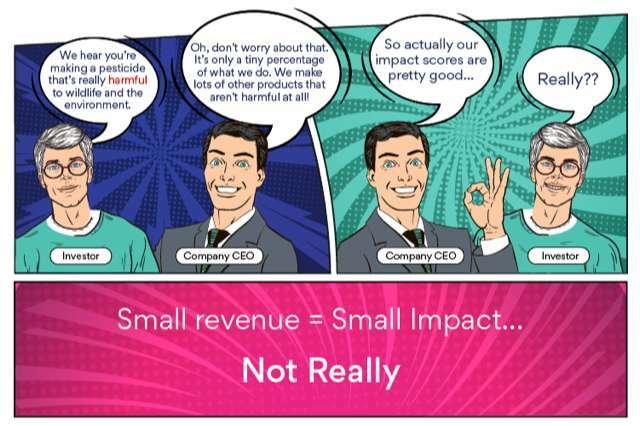
    This image represents the concept of double materiality in finance, emphasizing the importance of assessing impact over revenue. It illustrates how focusing solely on financial metrics can misrepresent a company's true societal and environmental effects, aligning with insights from GBAF's discussion on impact measurement.
    Illustration of double materiality in finance, highlighting impact over revenue - Global Banking & Finance Review
    Why waste money on news and opinion when you can access them for free?

    Take advantage of our newsletter subscription and stay informed on the go!

    Subscribe

    Tags:sustainabilityfinancial servicesinnovationcorporate social responsibility

    Quick Summary

    The team at GBAF spoke to Bertrand Gacon, CEO and Co-founder of Impact Measurement Platform: Impaakt, he gave his thoughts on double materiality and its link to impact.

    The team at GBAF spoke to Bertrand Gacon, CEO and Co-founder of Impact Measurement Platform: Impaakt, he gave his thoughts on double materiality and its link to impact.Why revenues are a red herring when it comes to impact double materiality

    In financial services, we’re hardwired to look in detail at any company we’re planning to invest in. We scrutinise revenues, earnings, margins and any other piece of financially relevant information we can get our hands on. When faced with the challenge of measuring impact, many of us take a similar approach. First, we ask what products and services the company provides. Then we try to assess the impact of each of these. Is it positive or negative, and to what degree? And, finally, we use a metric like revenues to work out the relative importance of each product or service and calculate an overall “impact score” for the company. 

    This seems logical, but it isn’t. Let’s look at an example. Imagine a company that makes a pesticide that is damaging to wildlife and human health. We note that this pesticide is harmful, but also that it’s only a very small percentage of the company’s revenues. The same company makes many other products that aren’t harmful. As a result, the company’s overall “impact score” might be quite positive. Does that feel right?

    I’d guess that your answer would be “no”. The problem is that, when you use revenues to gauge the importance of a product, you’re measuring its importance to the company but not its importance to everyone else. And impact is largely about everyone else, i.e. the planet and society as a whole.

    To measure impact, we need to look outwards, at the communities and environments that are affected, not inwards at the company’s revenues. We should have spent more time on that middle step in our assessment and tried to gauge the actual damage caused by the pesticide. That damage is something absolute – insect populations are being destroyed. This is not something that can be scaled up or down depending on the revenues that the product generates. When it comes to impact measurement, revenues are at best irrelevant and at worst highly misleading, when serious negative impacts are devalued or “offset” by less harmful activities. Revenues can also undervalue positive impacts. A great example here is Microsoft. Its LinkedIn product has a huge positive impact on employment, with three people hired every minute through the site. However, LinkedIn is only around 7% of Microsoft’s revenues, so a revenue-based model would downplay this contribution.

    The financial services industry needs to shake off its old-school approach. Everyone is talking about impact and double materiality but it’s ironic that, when we actually try to measure impact, we somehow end up focusing on what’s important to a company (single materiality) and don’t also consider what’s important to people and planet (double materiality). Of course, investors should try to understand the detailed operations of a company but, to measure impact effectively, we need a much more open and outward-looking mindset.

    The challenge is that impacts are not easily measured. In our pesticide example, they could be spread across the globe, with direct impacts on biodiversity and health, but also potential knock-on effects on jobs, food supply, water quality etc… You can see why some impact scoring models try to skirt around or downplay this step.

    However, while it’s difficult to measure impact, it isn’t impossible. Technology and global connectivity are on our side. We can now gather and assess huge amounts of information, using not just computer power and AI but also the collective intelligence of people all around the globe. We also have guiding principles in the form of the UN Sustainable Development Goals (SDGs), which include both environmental objectives like Life on Land and Life Below Water and social objectives like Zero Poverty and Quality Education. What is relevant for impact is not the contribution of a product to a company’s revenues, but its contribution (positive or negative) to one or more of these goals. We can address this challenge and we shouldn’t shy away from it or revert to outdated methodologies that fail to serve the purpose. With our collective approach to impact measurement, a global community of nearly 50,000 trained contributors decides whether something is material, and what its impact is on the world and the SDGs, not a single data provider with a revenue-based methodology. With this approach, double materiality becomes a reality, not just another way to greenwash an investment or company.

    Find out more about Impaakt and their collective approach to impact assessment.

    Frequently Asked Questions about Double-materiality is only useful when it is NOT associated with revenues

    1What is double materiality?

    Double materiality refers to the concept that companies should assess not only their financial performance but also the environmental and social impacts of their operations on society and the planet.

    2What is impact measurement?

    Impact measurement is the process of assessing the positive and negative effects of a company's products or services on society and the environment, beyond just financial metrics.

    3What are the UN Sustainable Development Goals?

    The UN Sustainable Development Goals are a set of 17 global objectives established by the United Nations to address various social, economic, and environmental challenges by 2030.

    4What is a revenue-based model?

    A revenue-based model is a method of evaluating a company's performance by focusing on its income generation, often used to assess the importance of different products or services.

    5What is corporate social responsibility?

    Corporate social responsibility (CSR) is a business model in which companies integrate social and environmental concerns into their operations and interactions with stakeholders.

    More from Investing

    Explore more articles in the Investing category

    Image for Understanding the Factors Shaping Bitcoin’s Current Market Conditions
    Understanding the Factors Shaping Bitcoin’s Current Market Conditions
    Image for Understanding Investment Management Consulting Services in the U.S. Market
    Understanding Investment Management Consulting Services in the U.S. Market
    Image for The Role of DST Sponsors and Service Providers in Delaware Statutory Trusts
    The Role of DST Sponsors and Service Providers in Delaware Statutory Trusts
    Image for Understanding Self-Directed IRA Structures and Platform Models
    Understanding Self-Directed IRA Structures and Platform Models
    Image for 1031 Exchanges and Delaware Statutory Trusts: What Investors Need to Know
    1031 Exchanges and Delaware Statutory Trusts: What Investors Need to Know
    Image for Excellence in Innovation – Strategic Investment & Economic Transformation Egypt 2025
    Excellence in Innovation – Strategic Investment & Economic Transformation Egypt 2025
    Image for What Is the Average Pension Pot in the UK? (By Age)
    What Is the Average Pension Pot in the UK? (By Age)
    Image for From Money Printing to Market Surge: The Macro Forces Driving Crypto in 2026
    From Money Printing to Market Surge: The Macro Forces Driving Crypto in 2026
    Image for  Millennials Aren’t Ignoring Retirement. They’re Rebuilding It.
    Millennials Aren’t Ignoring Retirement. They’re Rebuilding It.
    Image for BridgeWise Launches FixedWise, the First AI Solution Bringing Granular Bond Intelligence to the European Market
    BridgeWise Launches FixedWise, the First AI Solution Bringing Granular Bond Intelligence to the European Market
    Image for Why Financial Advisors Are Rethinking Gold Allocations
    Why Financial Advisors Are Rethinking Gold Allocations
    Image for From Opaque to Investable: Yaniv Bertele's Blueprint for Transparent Alternatives
    From Opaque to Investable: Yaniv Bertele's Blueprint for Transparent Alternatives
    View All Investing Posts
    Previous Investing PostAlternative data is an investor’s greatest ally against volatile markets
    Next Investing PostPPF Calculator – A tool to calculate your Maturity Returns