
Top Stories
Stocks sink with bond yield and dollar on recession fears
By Sinéad Carew and Nell Mackenzie
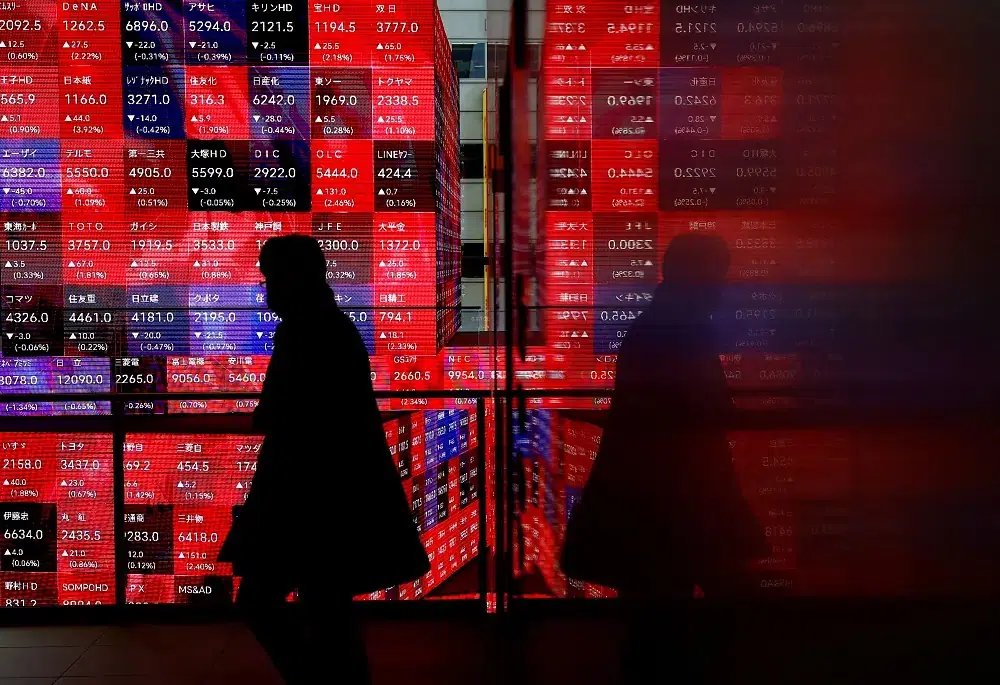
NEW YORK/LONDON (Reuters) -Global equities suffered heavy losses on Monday as Wall Street joined a global stock rout that started in Japan while the dollar tumbled against the yen and U.S. Treasury yields dropped on concerns about a recession in the United States.
Oil prices also fell in a volatile session on Monday, hit by recession fears, but declines were buffered by worries that escalating Middle East conflict could hit crude supplies.
CBOE’s volatility index, known as Wall Street’s fear gauge, pared gains and was last up 12.5 points at 35.98 after jumping 42 points earlier to 65.73, its highest level since March 2020, during the global COVID-19 pandemic.
Earlier Japan’s benchmark Nikkei average had closed down 12.40% for its largest one-day fall since October 1987.
A weaker than expected U.S. payrolls report for July had started a Wall Street sell-off on Friday when investor bets for a Federal Reserve September rate cut had doubled to 50 basis points. The weak report on Friday had followed disappointing earnings updates from some megacap technology companies.
“It’s really a confluence of things,” said Eric Wallerstein, chief market strategist at Yardeni Research in Los Angeles.
He said everything from unwinding of yen-funded trades and the escalation of Middle East tensions to the disappointing U.S. earnings updates and the weak U.S. jobs report, played a role in the sell-off.
However U.S. stocks pared losses somewhat after the Institute for Supply Management (ISM) said on Monday that services sector activity rebounded from a four-year low in July with rising orders and employment, easing recession fears.
Its non-manufacturing purchasing managers (PMI) index
rose to 51.4 from 48.8 in June, ahead of economist expectations for 51.0. A PMI reading above 50 indicates growth in services, which accounts for more than two-thirds of the U.S. economy.
On Wall Street, the Dow Jones Industrial Average was down 1,090.72 points, or 2.74% at 38,646.54 at 10:40 a.m. (1440 GMT). The S&P 500 lost 165.63 points, or 3.10%, to 5,180.93 and the Nasdaq Composite lost 590.17 points, or 3.52%, to 16,185.99.
MSCI’s gauge of stocks across the globe fell 26.19 points, or 3.33%, to 761.02 after earlier hitting a low of 756. Europe’s STOXX 600 index was down 2.29%.
In U.S. Treasuries, yields dropped to more than one-year lows and a closely-watched part of the Treasury yield curve turned positive for the first time in two years on increasing concerns that the U.S economy may be heading into a recession.
The yield on benchmark U.S. 10-year notes fell 2.3 basis points since late Friday to 3.773%, while the 30-year bond yield fell 3.4 basis points to 4.0772%.
The 2-year note yield, which typically moves in step with interest rate expectations, rose 0.9 basis points to 3.8811%.
In currencies, the Japanese yen surged to seven-month highs against the dollar as traders aggressively unwound carry trades interpreting last week’s U.S. economic data as raising the prospects for a U.S. recession and steeper Fed rate cuts.
The dollar index, which measures its performance against a basket of currencies including the yen and the euro, fell 0.53% to 102.60. The euro was up 0.5% at $1.0962.
Against the Japanese yen, the dollar weakened 2.12% to 143.44.
In energy markets, U.S. crude lost 0.71% to $73 a barrel and Brent fell to $76.39 per barrel, down 0.55% on the day.
In precious metals, gold appeared to lose some of its safe haven appeal. Spot gold lost 1.98% to $2,394.99 an ounce. U.S. gold futures fell 1.51% to $2,389.00 an ounce.
(Reporting by Sinéad Carew, Chibuike Oguh, Nell Mackenzie and Wayne Cole; Editing by Christina Fincher, Mark Potter and Tomasz Janowski)
A recession is a significant decline in economic activity across the economy that lasts for an extended period, typically visible in GDP, income, employment, manufacturing, and retail sales.
The dollar index measures the value of the U.S. dollar against a basket of foreign currencies, indicating the dollar's strength or weakness in the global market.
The volatility index, often referred to as the VIX, measures market expectations of near-term volatility, often used as a gauge of investor fear or uncertainty.
The purchasing managers' index (PMI) is an economic indicator that reflects the prevailing direction of economic trends in the manufacturing and service sectors.
Explore more articles in the Top Stories category