Trading
South Korean won, ETFs tumble after govt declares martial law
Published by Jessica Weisman-Pitts
Posted on December 3, 2024
2 min readLast updated: January 28, 2026
Published by Jessica Weisman-Pitts
Posted on December 3, 2024
2 min readLast updated: January 28, 2026
By Gertrude Chavez-Dreyfuss
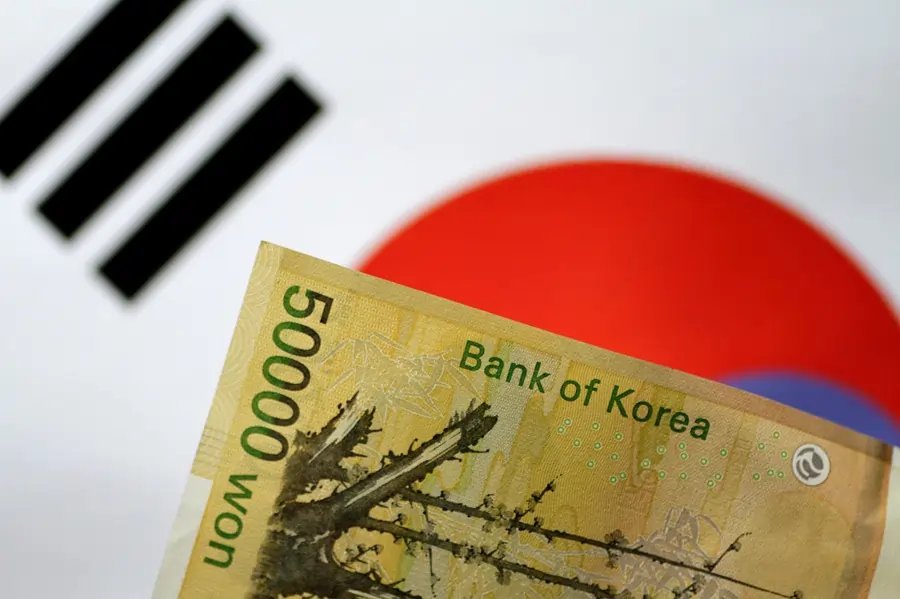
NEW YORK (Reuters) -The South Korean won dropped to a more than two-year low against the U.S. dollar on Tuesday, while exchange traded funds linked to South Korean stocks fell after President Yoon Suk Yeol declared martial law in an unannounced late-night address live on YTN television.
The South Korean unit fell to as low as 1,430.82 won per dollar, the lowest since October 2022. It was last down 1.9% at 1,430.60.
“It’s uncertainty driven.. one of those ‘shoot first, ask questions later’ (moves),” said Christopher Wong, FX and rates strategist at OCBC in Singapore. “Given the lack of information, the uncertainty may still keep Korean won under pressure in the interim.”
Yoon said he had no choice but to resort to such a measure in order to safeguard free and constitutional order, saying opposition parties have taken the parliamentary process hostage to throw the country into a crisis.
Stocks listed overseas swooned. The MSCI South Korea ETF fell 4.5%, while the Franklin FTSE South Korea ETF slid 3.2%.
With losses of more than 9% so far this year, the won is one of Asia’s worst performers and has been persistently under pressure as the Bank of Korea cut rates aggressively to support the economy and as investors fled a market they see as exposed heavily to exports and to U.S. trade tariffs on China.
The Korean won is already under pressure from the looming threat of tariffs and their detrimental impact on export-driven economies,” said Rong Ren Goh, a portfolio manager in the fixed income team at Eastspring Investments in Singapore.
“This latest development is likely to exacerbate the currency’s weakness, encouraging speculators to use the won as a high-beta proxy for expressing tariff-related risks.”
(Reporting by Gertrude Chavez-Dreyfuss, Vidya Ranganathan, Tom Westbrook and Cynthia Kim; Editing by Chizu Nomiyama and Alistair Bell)
The South Korean won is the official currency of South Korea, abbreviated as KRW. It is used for all transactions within the country and is subject to fluctuations in the foreign exchange market.
Exchange-traded funds (ETFs) are investment funds that are traded on stock exchanges, similar to stocks. They hold assets such as stocks, commodities, or bonds and generally operate with an arbitrage mechanism designed to keep trading close to its net asset value.
Currency depreciation refers to a decrease in the value of a currency relative to other currencies. This can occur due to various factors, including economic instability, inflation, or changes in interest rates.
Monetary policy is the process by which a central bank manages the supply of money and interest rates to achieve specific economic objectives, such as controlling inflation, consumption, growth, and liquidity.
Explore more articles in the Trading category