
Search
00
GBAF Logo
trophy
Top StoriesInterviewsBusinessFinanceBankingTechnologyInvestingTradingVideosAwardsMagazinesHeadlinesTrends

Subscribe to our newsletter

Get the latest news and updates from our team.

Global Banking & Finance Review®

Global Banking & Finance Review® - Subscribe to our newsletter

Company

    GBAF Logo
    • About Us
    • Profile
    • Privacy & Cookie Policy
    • Terms of Use
    • Contact Us
    • Advertising
    • Submit Post
    • Latest News
    • Research Reports
    • Press Release
    • Awards▾
      • About the Awards
      • Awards TimeTable
      • Submit Nominations
      • Testimonials
      • Media Room
      • Award Winners
      • FAQ
    • Magazines▾
      • Global Banking & Finance Review Magazine Issue 79
      • Global Banking & Finance Review Magazine Issue 78
      • Global Banking & Finance Review Magazine Issue 77
      • Global Banking & Finance Review Magazine Issue 76
      • Global Banking & Finance Review Magazine Issue 75
      • Global Banking & Finance Review Magazine Issue 73
      • Global Banking & Finance Review Magazine Issue 71
      • Global Banking & Finance Review Magazine Issue 70
      • Global Banking & Finance Review Magazine Issue 69
      • Global Banking & Finance Review Magazine Issue 66
    Top StoriesInterviewsBusinessFinanceBankingTechnologyInvestingTradingVideosAwardsMagazinesHeadlinesTrends

    Global Banking & Finance Review® is a leading financial portal and online magazine offering News, Analysis, Opinion, Reviews, Interviews & Videos from the world of Banking, Finance, Business, Trading, Technology, Investing, Brokerage, Foreign Exchange, Tax & Legal, Islamic Finance, Asset & Wealth Management.
    Copyright © 2010-2026 GBAF Publications Ltd - All Rights Reserved. | Sitemap | Tags | Developed By eCorpIT

    Editorial & Advertiser disclosure

    Global Banking & Finance Review® is an online platform offering news, analysis, and opinion on the latest trends, developments, and innovations in the banking and finance industry worldwide. The platform covers a diverse range of topics, including banking, insurance, investment, wealth management, fintech, and regulatory issues. The website publishes news, press releases, opinion and advertorials on various financial organizations, products and services which are commissioned from various Companies, Organizations, PR agencies, Bloggers etc. These commissioned articles are commercial in nature. This is not to be considered as financial advice and should be considered only for information purposes. It does not reflect the views or opinion of our website and is not to be considered an endorsement or a recommendation. We cannot guarantee the accuracy or applicability of any information provided with respect to your individual or personal circumstances. Please seek Professional advice from a qualified professional before making any financial decisions. We link to various third-party websites, affiliate sales networks, and to our advertising partners websites. When you view or click on certain links available on our articles, our partners may compensate us for displaying the content to you or make a purchase or fill a form. This will not incur any additional charges to you. To make things simpler for you to identity or distinguish advertised or sponsored articles or links, you may consider all articles or links hosted on our site as a commercial article placement. We will not be responsible for any loss you may suffer as a result of any omission or inaccuracy on the website.

    Home > Top Stories > BASF readies more ammonia production cuts in gas supply crunch
    Top Stories

    BASF readies more ammonia production cuts in gas supply crunch
    Published by Wanda Rich

    Posted on July 27, 2022

    4 min read

    Last updated: February 5, 2026

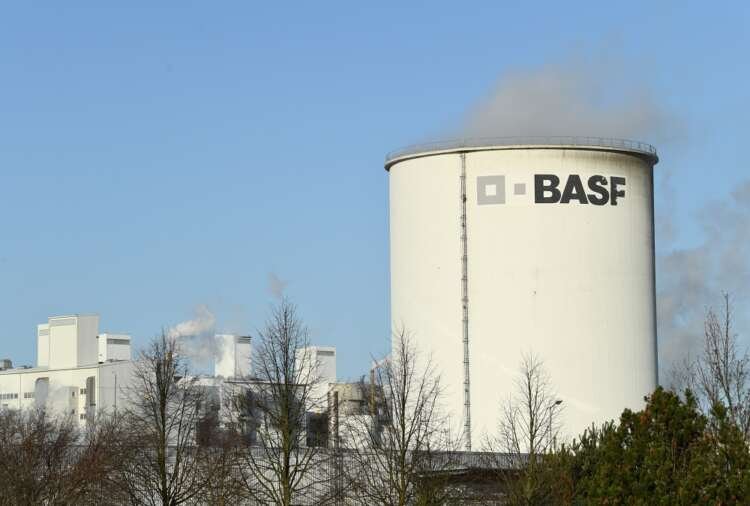
    This image shows BASF's chemical plant in Schwarzheide, Germany, highlighting the company's recent decision to cut ammonia production due to soaring natural gas prices and supply challenges. Ammonia's vital role in agriculture and industry underscores the implications of these cuts.
    BASF chemical plant in Germany facing ammonia production cuts due to gas supply issues - Global Banking & Finance Review
    Why waste money on news and opinion when you can access them for free?

    Take advantage of our newsletter subscription and stay informed on the go!

    Subscribe

    Tags:sustainabilityagricultural sectors

    By Ludwig Burger

    FRANKFURT (Reuters) -Germany’s BASF, the world’s largest chemical company, is cutting ammonia production further due to soaring natural gas prices, it said on Wednesday, with potential ramifications from farming to fizzy drinks.

    Germany’s biggest ammonia maker SKW Piesteritz and number four Ineos also said they could not rule out production cuts as the country grapples with disruption to Russian gas supplies.

    Ammonia plays a key role in the manufacturing of fertiliser, engineering plastics and diesel exhaust fluid. Its production also yields high-purity carbon dioxide (CO2) as a byproduct, which is needed by the meat and fizzy drinks industries.

    “We are reducing production at facilities that require large volumes of natural gas, such as ammonia plants,” BASF Chief Executive said in a media call after the release of quarterly results, confirming an earlier Reuters report.

    He added BASF would purchase some ammonia from external suppliers to fill gaps but warned farmers would face soaring fertiliser costs next year.

    Production lines for raw material syngas, a mixture of carbon monoxide and hydrogen, and basic petrochemical acetylene were also candidates for cutbacks to save on gas, the CEO said.

    Unlike many European countries, Germany has no liquefied natural gas (LNG) port terminals to replace Russian pipeline gas. That means companies are under political and commercial pressure to reduce gas intensive activities if gas deliveries are cut further.

    BASF cut ammonia output at its headquarters in Ludwigshafen and at its large chemical complex in Antwerp, Belgium, in September.

    Fertiliser giant Yara, which runs Germany’s third-largest ammonia production site in the northern town of Brunsbuettel, said its output across Europe was currently 27% below capacity due to the surge in gas prices.

    It would not specify the Brunsbuettel rate, but added the site does not deliver any high-purity CO2.

    SKW said it was in the process of resuming full production after a scheduled maintenance shutdown but the future capacity utilisation rate was extremely difficult to predict.

    Chemical companies are the biggest industrial natural-gas users in Germany and ammonia is the single most gas-intensive product within that industry.

    Companies that reduce ammonia production may lose market share to imports from overseas suppliers with access to cheap gas, or in Germany might accept compensation payments under a potential gas rationing programme to encourage manufacturers to quickly scale back production to balance out supply cuts.

    PRIME CANDIDATE

    Most ammonia goes into nitrogen fertilisers but other uses include diesel exhaust fluid AdBlue and engineering plastics.

    Ammonia production would be a prime candidate for cuts to cushion any gas supply squeeze over the next few months, said Arne Rautenberg, a fund manager at Union Investment.

    “In the northern hemisphere, nitrogen fertiliser is applied primarily during the spring. It can also be produced in the United States and shipped to Europe,” he said, while adding CO2 supply for the food industry could prove a thorny issue.

    BASF’s production network, in particular, does not rely on ammonia as much as it does on other basic chemicals for onward use in more specialised downstream chemicals, Rautenberg said.

    Russia resumed pumping gas via its biggest pipeline to Europe, Nord Stream 1, on July 21 after a 10-day maintenance outage, but Gazprom on Monday said supplies to Germany would drop to just 20% of capacity.

    Even before the war in Ukraine, reduced ammonia production due to rocketing natural gas prices in Britain last year caused CO2 shortages in the meat and drinks industries.

    That forced the UK government in September to provide financial support for ammonia maker CF Industries to restart production.

    During normal times, ammonia production accounts for about 4.5% of the natural gas used by German industry.

    Both SKW and BASF cut ammonia production in September 2021, because of a surge in gas prices.

    SKW, which at the time cut output by 20%, resumed normal production when customers accepted price mark-ups.

    SKW can cut output at each of its two production lines for ammonia and urea by no more than 20% or it would have to suspend output entirely in a costly ramp-down, a spokesperson said.

    Britain’s Ineos said it was watching energy costs very closely and “will adjust production to make best use of low peak energy and purchasing of raw materials”.

    Ammonia production has been reduced considerably in German already because of high gas prices, said chemical industry lobby VCI.

    SKW said it was providing CO2 to the food industry, with Air Liquide as intermediary. BASF also said it was providing CO2 through industrial gases companies.

    Across the industry, cash costs of ammonia production in Europe during the first-quarter were five times the average 2019 level and far above other world regions, according to data compiled by Boston Consulting group.

    (Reporting by Ludwig Burger Editing by Matt Scuffham and Mark Potter)

    Frequently Asked Questions about BASF readies more ammonia production cuts in gas supply crunch

    1What is ammonia?

    Ammonia is a colorless gas with a distinct odor, used primarily in the production of fertilizers, engineering plastics, and diesel exhaust fluid. It is also a key component in various industrial processes.

    2What is natural gas?

    Natural gas is a fossil fuel primarily composed of methane. It is used as an energy source for heating, electricity generation, and as a feedstock in chemical production, including ammonia.

    3What is fertiliser?

    Fertiliser is a chemical or natural substance added to soil to enhance its fertility and promote plant growth. It often contains essential nutrients like nitrogen, phosphorus, and potassium.

    4What is syngas?

    Syngas, or synthesis gas, is a mixture of carbon monoxide and hydrogen produced from gasifying carbon-containing materials. It is used as an intermediate in producing ammonia and other chemicals.

    5What is high-purity carbon dioxide?

    High-purity carbon dioxide is a refined form of CO2 used in various industries, including food and beverage, for carbonation and preservation, as well as in meat processing.

    More from Top Stories

    Explore more articles in the Top Stories category

    Image for Lessons From the Ring and the Deal Table: How Boxing Shapes Steven Nigro’s Approach to Banking and Life
    Lessons From the Ring and the Deal Table: How Boxing Shapes Steven Nigro’s Approach to Banking and Life
    Image for Joe Kiani in 2025: Capital, Conviction, and a Focused Return to Innovation
    Joe Kiani in 2025: Capital, Conviction, and a Focused Return to Innovation
    Image for Marco Robinson – CLOSE THE DEAL AND SUDDENLY GROW RICH
    Marco Robinson – CLOSE THE DEAL AND SUDDENLY GROW RICH
    Image for Digital Tracing: Turning a regulatory obligation into a commercial advantage
    Digital Tracing: Turning a regulatory obligation into a commercial advantage
    Image for Exploring the Role of Blockchain and the Bitcoin Price Today in Education
    Exploring the Role of Blockchain and the Bitcoin Price Today in Education
    Image for Inside the World’s First Collection Industry Conglomerate: PCA Global’s Platform Strategy
    Inside the World’s First Collection Industry Conglomerate: PCA Global’s Platform Strategy
    Image for Chase Buchanan Private Wealth Management Highlights Key Autumn 2025 Budget Takeaways for Expats
    Chase Buchanan Private Wealth Management Highlights Key Autumn 2025 Budget Takeaways for Expats
    Image for PayLaju Strengthens Its Position as Malaysia’s Trusted Interest-Free Sharia-Compliant Loan Provider
    PayLaju Strengthens Its Position as Malaysia’s Trusted Interest-Free Sharia-Compliant Loan Provider
    Image for A Notable Update for Employee Health Benefits:
    A Notable Update for Employee Health Benefits:
    Image for Creating Equity Between Walls: How Mohak Chauhan is Using Engineering, Finance, and Community Vision to Reengineer Affordable Housing
    Creating Equity Between Walls: How Mohak Chauhan is Using Engineering, Finance, and Community Vision to Reengineer Affordable Housing
    Image for Upcoming Book on Real Estate Investing: Harvard Grace Capital Founder Stewart Heath’s Puts Lessons in Print
    Upcoming Book on Real Estate Investing: Harvard Grace Capital Founder Stewart Heath’s Puts Lessons in Print
    Image for ELECTIVA MARKS A LANDMARK FIRST YEAR WITH MAJOR SENIOR APPOINTMENTS AND EXPANSION MILESTONES
    ELECTIVA MARKS A LANDMARK FIRST YEAR WITH MAJOR SENIOR APPOINTMENTS AND EXPANSION MILESTONES
    View All Top Stories Posts
    Previous Top Stories PostSteel pipemaker Vallourec expects full-year core profit jump
    Next Top Stories PostDeutsche Bank extends profit streak in Q2 but warns on economy