
Search
00
GBAF Logo
trophy
Top StoriesInterviewsBusinessFinanceBankingTechnologyInvestingTradingVideosAwardsMagazinesHeadlinesTrends

Subscribe to our newsletter

Get the latest news and updates from our team.

Global Banking & Finance Review®

Global Banking & Finance Review® - Subscribe to our newsletter

Company

    GBAF Logo
    • About Us
    • Profile
    • Privacy & Cookie Policy
    • Terms of Use
    • Contact Us
    • Advertising
    • Submit Post
    • Latest News
    • Research Reports
    • Press Release
    • Awards▾
      • About the Awards
      • Awards TimeTable
      • Submit Nominations
      • Testimonials
      • Media Room
      • Award Winners
      • FAQ
    • Magazines▾
      • Global Banking & Finance Review Magazine Issue 79
      • Global Banking & Finance Review Magazine Issue 78
      • Global Banking & Finance Review Magazine Issue 77
      • Global Banking & Finance Review Magazine Issue 76
      • Global Banking & Finance Review Magazine Issue 75
      • Global Banking & Finance Review Magazine Issue 73
      • Global Banking & Finance Review Magazine Issue 71
      • Global Banking & Finance Review Magazine Issue 70
      • Global Banking & Finance Review Magazine Issue 69
      • Global Banking & Finance Review Magazine Issue 66
    Top StoriesInterviewsBusinessFinanceBankingTechnologyInvestingTradingVideosAwardsMagazinesHeadlinesTrends

    Global Banking & Finance Review® is a leading financial portal and online magazine offering News, Analysis, Opinion, Reviews, Interviews & Videos from the world of Banking, Finance, Business, Trading, Technology, Investing, Brokerage, Foreign Exchange, Tax & Legal, Islamic Finance, Asset & Wealth Management.
    Copyright © 2010-2026 GBAF Publications Ltd - All Rights Reserved. | Sitemap | Tags | Developed By eCorpIT

    Editorial & Advertiser disclosure

    Global Banking & Finance Review® is an online platform offering news, analysis, and opinion on the latest trends, developments, and innovations in the banking and finance industry worldwide. The platform covers a diverse range of topics, including banking, insurance, investment, wealth management, fintech, and regulatory issues. The website publishes news, press releases, opinion and advertorials on various financial organizations, products and services which are commissioned from various Companies, Organizations, PR agencies, Bloggers etc. These commissioned articles are commercial in nature. This is not to be considered as financial advice and should be considered only for information purposes. It does not reflect the views or opinion of our website and is not to be considered an endorsement or a recommendation. We cannot guarantee the accuracy or applicability of any information provided with respect to your individual or personal circumstances. Please seek Professional advice from a qualified professional before making any financial decisions. We link to various third-party websites, affiliate sales networks, and to our advertising partners websites. When you view or click on certain links available on our articles, our partners may compensate us for displaying the content to you or make a purchase or fill a form. This will not incur any additional charges to you. To make things simpler for you to identity or distinguish advertised or sponsored articles or links, you may consider all articles or links hosted on our site as a commercial article placement. We will not be responsible for any loss you may suffer as a result of any omission or inaccuracy on the website.

    Home > Top Stories > Analysis-Credit Suisse collapse threatens Switzerland’s wealth management crown
    Top Stories

    Analysis-Credit Suisse collapse threatens Switzerland’s wealth management crown
    Published by Jessica Weisman-Pitts

    Posted on March 22, 2023

    5 min read

    Last updated: February 2, 2026

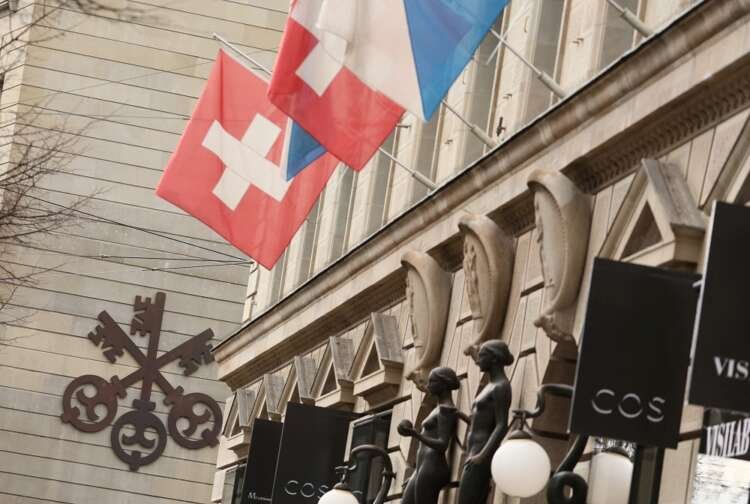
    The image features the logos of Credit Suisse and UBS alongside a Swiss flag, reflecting the recent collapse of Credit Suisse and its implications for Switzerland's wealth management industry.
    Credit Suisse logo with Swiss flag, highlighting banking instability - Global Banking & Finance Review
    Why waste money on news and opinion when you can access them for free?

    Take advantage of our newsletter subscription and stay informed on the go!

    Subscribe

    Tags:financial sectorcorporate governanceWealth Managementeconomic growthfinancial crisis

    By John Revill

    ZURICH (Reuters) – The fall of Credit Suisse has dealt a serious blow to Switzerland’s credentials as the world’s leading wealth management centre, experts warn, calling into question its reputation for stability, regulation and corporate governance.

    Battered by years of scandals and losses, Credit Suisse had been fighting a crisis of confidence for months, before its demise was sealed in just a matter of days last week when Swiss authorities brokered a takeover of the bank by larger rival UBS.

    UBS itself needed to be rescued by the government in 2008 after a disastrous foray into U.S. mortgage securities.

    The Credit Suisse collapse and its aftermath “is going to be very damaging,” said Arturo Bris, Professor of Finance at the International Institute for Management Development (IMD) in Lausanne, adding it could benefit rival financial centres.

    Switzerland manages $2.6 trillion in international assets according to a 2021 Deloitte study, making it the world’s largest financial centre ahead of Britain and the United States. But it faces competition from other centres including Luxembourg and in particular Singapore, which has grown rapidly in recent years.

    “The bankers in Singapore are going to be uncorking the champagne bottles,” Bris told Reuters.

    Switzerland’s credibility as a stable, predictable country had been upended by moves like the decision to wipe out the holdings of Credit Suisse bondholders, he said.

    Under the takeover deal, holders of Credit Suisse AT1 bonds will get nothing, while shareholders, who usually rank below bondholders in compensation terms, will receive $3.23 billion.

    While Credit Suisse’s AT1 prospectus made clear that hybrid (AT1) holders would not recover any value, few anticipated the bank’s demise.

    The Swiss Bankers Association has attempted to put a brave face on the crisis, presenting the rescue engineered by the government, central bank and regulator as sign of strength.

    “The Swiss financial sector was able to address a major issue of a significant player,” SBA Chairman and former UBS CEO Marcel Rohner told reporters on Tuesday.

    “In that sense I also see a prosperous future for the financial centre because we have hundreds of very well capitalised banks and very successful wealth management and asset management banks.”

    Still, the number of banks has fallen, down to 239 in 2021 from 356 in 2002. Staff numbers since 2011 have slipped to 91,000 from 108,000.

    Graphic: Banks in Switzerland Banks in Switzerland – https://www.reuters.com/graphics/GLOBALBANKS-CREDITSUISSE/gkvlwbblepb/chart.png

    Graphic: Swiss banking sector staff – https://www.reuters.com/graphics/GLOBALBANKS-CREDITSUISSE/zjvqjnybgpx/chart.png

    Others were more skeptical about the future, highlighting a reluctance to confront mistakes at Credit Suisse or take responsibility for the aftermath.

    “There are a lot of open questions: the use of emergency law overriding the views of shareholders or the treatment of bond holders,” said Stefan Legge, head of tax and trade policy at the University of St. Gallen’s IFF Institute for Financial Studies.

    “Maybe some people are a bit delusional – and really believe they are doing a great job.”

    Switzerland invoked emergency legislation to allow a public liquidity backstop (PLB) which will provide up to 100 billion Swiss francs in liquidity to Credit Suisse as the PLB was not yet part of Swiss law.

    But perhaps most controversially, the emergency law allowed the takeover to go ahead without shareholder approval.

    Legge said the collapse should serve as a wake-up call, and could see new laws to improve corporate governance introduced.

    Switzerland has few mechanisms for holding top bankers individually responsible for mismanagement, unlike centres such as Britain where senior managers can face criminal sanctions.

    Unions and politicians have also reacted angrily to the rescue, which could leave the taxpayer having to cover up to 9 billion francs in losses.

    LONG DECLINE

    Switzerland’s outsized banking sector has been under pressure for years following a decline in banking secrecy as other countries sought to clamp down on tax evasion by citizens.

    The financial sector’s contribution to the Swiss economy has also slipped, falling to 8.9% of Swiss GDP in 2022 from 9.9% in 2002 as industries like pharmaceuticals became more important in a country with the third highest GDP per capita in the world, according to IMF data.

    Graphic: Declining weight of the Swiss financial sector – https://www.reuters.com/graphics/GLOBALBANKS-CREDITSUISSE/dwvkdkzbmpm/chart.png

    BAK Economics, a Swiss research institute, said the fallout from the debacle would be contained within the banking sector. It estimated up to 12,000 Swiss jobs being lost, although the impact on the broader economy would be limited.

    Jan-Egbert Sturm director of the KOF Swiss Economic Institute at ETH Zurich, a university, predicted the economic impact of Credit Suisse’s demise would amount to a loss of around 0.05% of GDP per year.

    Switzerland’s long banking tradition and structural advantages meant the country would remain heavily involved in banking in future, he said, with investors still choosing it for its stability and the strength of its Swiss franc currency.

    Still competition was getting fiercer, and the recent events would eventually see Singapore overtake Switzerland, warned IMD’s Bris.

    “I think it’s only a matter of time.”

    (Reporting by John Revill, additional reporting by Paul Arnold, Editing by Alexandra Hudson)

    Frequently Asked Questions about Analysis-Credit Suisse collapse threatens Switzerland’s wealth management crown

    1What is wealth management?

    Wealth management is a comprehensive service that combines investment management, financial planning, and other financial services tailored to meet the needs of high-net-worth individuals.

    2What is corporate governance?

    Corporate governance refers to the systems, principles, and processes by which companies are directed and controlled, ensuring accountability and transparency in a company's operations.

    3What is a financial crisis?

    A financial crisis is a situation in which the value of financial institutions or assets drops significantly, often leading to widespread economic disruption and loss of confidence in the financial system.

    4What is the role of a central bank?

    A central bank is a national institution that manages a country's currency, money supply, and interest rates, and oversees the banking system to ensure financial stability.

    5What are international assets?

    International assets are investments held in foreign countries, including stocks, bonds, and real estate, which can diversify a portfolio and mitigate risks associated with domestic markets.

    More from Top Stories

    Explore more articles in the Top Stories category

    Image for Lessons From the Ring and the Deal Table: How Boxing Shapes Steven Nigro’s Approach to Banking and Life
    Lessons From the Ring and the Deal Table: How Boxing Shapes Steven Nigro’s Approach to Banking and Life
    Image for Joe Kiani in 2025: Capital, Conviction, and a Focused Return to Innovation
    Joe Kiani in 2025: Capital, Conviction, and a Focused Return to Innovation
    Image for Marco Robinson – CLOSE THE DEAL AND SUDDENLY GROW RICH
    Marco Robinson – CLOSE THE DEAL AND SUDDENLY GROW RICH
    Image for Digital Tracing: Turning a regulatory obligation into a commercial advantage
    Digital Tracing: Turning a regulatory obligation into a commercial advantage
    Image for Exploring the Role of Blockchain and the Bitcoin Price Today in Education
    Exploring the Role of Blockchain and the Bitcoin Price Today in Education
    Image for Inside the World’s First Collection Industry Conglomerate: PCA Global’s Platform Strategy
    Inside the World’s First Collection Industry Conglomerate: PCA Global’s Platform Strategy
    Image for Chase Buchanan Private Wealth Management Highlights Key Autumn 2025 Budget Takeaways for Expats
    Chase Buchanan Private Wealth Management Highlights Key Autumn 2025 Budget Takeaways for Expats
    Image for PayLaju Strengthens Its Position as Malaysia’s Trusted Interest-Free Sharia-Compliant Loan Provider
    PayLaju Strengthens Its Position as Malaysia’s Trusted Interest-Free Sharia-Compliant Loan Provider
    Image for A Notable Update for Employee Health Benefits:
    A Notable Update for Employee Health Benefits:
    Image for Creating Equity Between Walls: How Mohak Chauhan is Using Engineering, Finance, and Community Vision to Reengineer Affordable Housing
    Creating Equity Between Walls: How Mohak Chauhan is Using Engineering, Finance, and Community Vision to Reengineer Affordable Housing
    Image for Upcoming Book on Real Estate Investing: Harvard Grace Capital Founder Stewart Heath’s Puts Lessons in Print
    Upcoming Book on Real Estate Investing: Harvard Grace Capital Founder Stewart Heath’s Puts Lessons in Print
    Image for ELECTIVA MARKS A LANDMARK FIRST YEAR WITH MAJOR SENIOR APPOINTMENTS AND EXPANSION MILESTONES
    ELECTIVA MARKS A LANDMARK FIRST YEAR WITH MAJOR SENIOR APPOINTMENTS AND EXPANSION MILESTONES
    View All Top Stories Posts
    Previous Top Stories PostOil up 2% as dollar weakens on small US Fed rate hike
    Next Top Stories PostFed in spotlight with US focus on stability, First Republic